Why Does Manufacturing AI Stop at PoC?

Hello, this is Mithril.
The movement to introduce AI into manufacturing sites is growing rapidly. Projects are underway across various fields to detect equipment anomalies in advance, automatically identify defects, and monitor worker safety in real time.
However, many projects stall at a similar point. While PoC (Proof of Concept) shows high accuracy and impressive results, the moment it is applied to actual production lines, a wave of new questions arises:
"Can field workers trust and use this result?"
"Will it continue to work even if equipment conditions change?"
"Who determines and responds when false positives or false negatives occur?"
"Can we handle the operational and maintenance costs?"
The success or failure of manufacturing AI is not determined solely by model performance. A system is complete only when an operational structure and responsibility framework—enabling repeated use on site—are designed together.
In this article, we will examine why manufacturing AI projects fail to expand beyond PoC and look into the design principles required to transition into a practical operational phase.

PoC Success and Field Application Success Are Different
PoC is a process to confirm feasibility. It validates whether AI can solve a problem based on a limited timeframe, selected data, and relatively clear objectives. On the other hand, actual operation is far more complex:
Lighting changes depending on the season and time of day.
Raw materials and product models change.
Equipment is replaced or parameter settings are adjusted.
Positions of cameras and sensors shift slightly.
Workers and production speeds vary.
Data loss or network failures occur.
Humans must make the final check on AI judgments.
In a PoC, a model accuracy of 95% might look like an impressive achievement. However, on a production line executing tens of thousands of judgments daily, a 5% error rate can translate into hundreds of false alarms.
Therefore, during the operational phase, the following questions are more critical than simple accuracy:
Under what conditions does it make errors?
When it fails, how does it impact production and safety?
How quickly can errors be detected and corrected?
Adopting AI is less about installing a model and more about designing a system so that business operations do not grind to a halt even when the model makes mistakes.

The Core of Manufacturing AI Is Data Flow, Not the Model
Data at manufacturing sites is not accumulated in an AI-ready format from the beginning. Videos contain unnecessary footage, sensor data has missing values, and time synchronization between production history and quality results is often mismatched. There are also cases where items classified as defects on site are recorded as normal in the system.
What happens if you only refine the model under these conditions? The model may perform well on training data, but on actual production lines, results can fluctuate even with slight condition changes. It also becomes difficult to identify whether the root cause lies in the model, the data, or equipment conditions.
To build an operational manufacturing AI, the following flow must be managed comprehensively:
Data Collection: Organize collection intervals and time synchronization across various data sources like cameras, PLCs, MES, SCADA, and equipment logs.
Data Consistency: Link data from disparate systems to identical production events. Key identifiers include Product ID, Lot, Process Step, Equipment ID, and Event Timestamp.
Labeling Standards: Document criteria for normal, anomalous, and defective conditions along with exception rules so workers do not make conflicting judgments.
Quality Validation: Beyond pre-training sample inspections, continuously verify whether newly generated operational data aligns with established standards.
Retraining & Deployment: Once changes in production conditions are identified, retrain the model and safely deploy validated versions.
Without this cycle, AI becomes a system whose performance degrades over time after initial deployment.
Reducing Alarms Is Not Performance Improvement
On the shop floor, generating too many AI alarms quickly leads to user fatigue. Eventually, workers may ignore alarms or abandon the system altogether.
As a result, systems are often adjusted simply to decrease alarm counts. However, merely raising threshold values is insufficient. For example, both of the following scenarios can trigger an "Anomalous Alarm":
An abnormal sign leading to actual equipment failure.
A temporary shift with no impact on production.
If the system fails to distinguish between the two, alarm volume increases and critical signals get buried under routine warnings.
A field-centric AI system should not only signal anomalies but also supply the necessary context for decision-making:
Which equipment did it occur on?
Has a similar pattern occurred before?
Which sensors and visual data served as the basis?
What is the potential impact on production quality or safety?
Does it require an immediate stop, or simple observation?
What should the operator inspect next?
AI's role is not to make every decision on behalf of humans, but to empower humans to make faster, more consistent decisions.
What the Shop Floor Needs Is 'Collaboration', Not 'Replacement'
In manufacturing environments, combining human experience with AI's analytical capabilities is often far more practical than attempting to fully replace workers with AI.
Workers possess unrecorded contextual knowledge—such as equipment sound, vibration, smell, and operation sequences. AI excels at discovering subtle changes and repetitive patterns that humans cannot continuously observe over long periods.
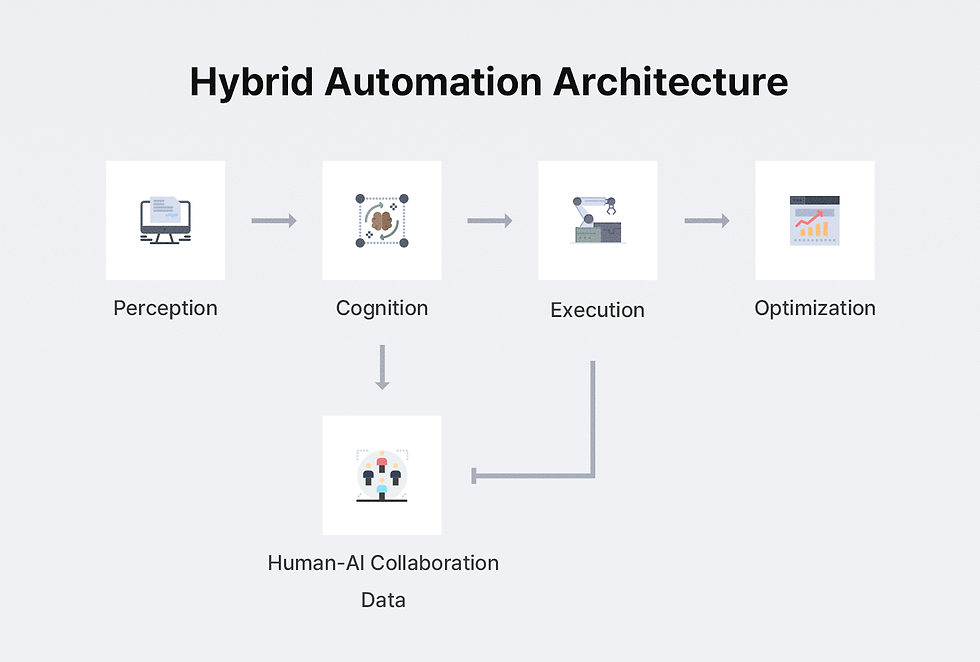
Combining both capabilities creates the following workflow:
AI detects potential anomalous conditions.
The system presents relevant video, sensor data, and production history together.
The worker verifies the actual site status.
The worker provides feedback on the result (e.g., normal, false positive, actual anomaly).
Standards and models are improved based on accumulated feedback.
In this structure, worker verification logs are not mere task records. They serve as valuable training assets that improve site data quality and drive subsequent model updates. Ultimately, effective manufacturing AI does not push humans out of the system; it redesigns roles so people can utilize the system better.
Without Operational Responsibility, AI Stalls Too
Various issues can arise after an AI system is deployed in the field:
Camera lenses get dirty.
Lighting conditions change.
Networks become unstable.
Sensors are replaced.
Product specifications change.
New defect types emerge.
Personnel changes occur.
Under these circumstances, relying on the assumption that "AI will handle it automatically" prevents stable operations. At minimum, the following responsibilities must be defined prior to implementation:
Site Operations: Alarm verification, primary response, anomaly logging.
Equipment & Automation: Status management for sensors, cameras, PLCs, and network infrastructure.
Data: Collection status, labeling standards, data quality management.
AI Model: Performance monitoring, retraining, version management.
IT & Security: Account management, access control, log oversight, server/backup management.
Decision Making: Authorization for production stops, equipment inspections, and model updates.
In particular, when AI is linked to production halts or safety actions, the degree of automation must be determined carefully. Policies should clarify whether controls execute immediately based solely on AI judgment, require worker confirmation, or vary according to the situation.
Three Criteria for Scaling Manufacturing AI
Expanding AI successful in one line to other lines or plants requires more than just copying model files.
Criterion 1. Is the data structure standardized?
If data names and formats differ across equipment, every expansion demands new development. Common data structures—such as Equipment ID, Process Step, Event Time, and Quality Results—must be defined first.
Criterion 2. Can model performance be continuously measured?
Do not record accuracy only at the initial rollout stage. Track performance changes over operating periods alongside variances across products, equipment, and environments.
Criterion 3. Is field deployment repeatable?
If every new line requires manual installation and setup, scaling costs escalate rapidly. Models, parameter settings, data connections, user permissions, and monitoring screens must be deployable through standardized procedures.
Scalable AI is not a static deliverable optimized for a single project, but an operational system repeatable across multiple sites.
Mithril's Vision for Manufacturing AI
Manufacturing AI will not advance solely with higher accuracy as its goal. Moving forward, the following factors are likely to be evaluated together:
Does it contribute to actual productivity and quality improvement?
Can field users understand the results and take action?
Can the state of data and models be managed continuously?
Can it adapt to changes in equipment and processes?
Can the root causes be traced when failures or misjudgments occur?
Can it scale to other lines and plants?
In industrial settings, understanding why a decision was made and what to do next is just as critical as what the AI predicted. Mithril understands field data and workflows together, designing structures that allow AI models to be utilized continuously in real operational environments. AI adoption does not end with model creation; it encompasses connecting data, structuring decision-making processes, and aligning site operations with systems.

Questions to Ask Before Field Deployment
If you are considering a manufacturing AI project, start by reviewing these questions:
Is the problem you are trying to solve clear in terms of production, quality, or safety?
Has sufficient data been accumulated for the AI to make decisions?
Is there an agreed-upon standard for distinguishing normal from abnormal conditions?
Which is more dangerous: false positives or false negatives?
Is there a designated person to review AI results and take action?
Do you have a plan to handle changes in equipment, products, or environments?
Who will manage model and data quality post-deployment?
Are budget and timeline prepared for actual site rollout after PoC completion?
Answering these questions increases the likelihood that AI adoption will move beyond simple technical validation to real operational improvement.
Review Your Strategy with Mithril
Implementing AI on the shop floor is not just a technology issue. Field workflows, equipment data, quality standards, operating personnel, security policies, and maintenance systems must all be reviewed together. Mithril clarifies industrial issues, connects data with AI, and designs implementation strategies that span from PoC to real-world operations and expansion.
If you are struggling with where to begin, start by evaluating practical feasibility based on your current data and site challenges. Discuss your manufacturing AI direction with Mithril.


Comments