The Era of 5 Million Robots: Where Does a Factory's Competitive Edge Come From?
Installing more robots is fundamentally different from building a smarter factory.
In September 2026, the International Federation of Robotics (IFR) reported that the number of operational industrial robots in factories worldwide reached 5 million as of the end of 2025. Over 600,000 new units were installed in a single year alone. The core question in manufacturing is now shifting from "Should we adopt robots?" to "How can we operate our existing robots and equipment more intelligently?"
In response, the Korean government unveiled its "Manufacturing AI 2030 Strategy," targeting a joint public-private investment of 20 trillion KRW by 2030 to accelerate AI adoption in manufacturing and create over 100 trillion KRW in economic value. Both global manufacturing trends and domestic policies are pointing toward the same direction: Manufacturing AX (AI Transformation), which goes beyond automating individual machines to connect data, decision-making, and execution across the entire factory floor.

The Shift Behind the Numbers
When you line up recent announcements across manufacturing, AI, and robotics, the direction of change becomes strikingly clear:
IFR reported that the global operational stock of industrial robots has reached 5 million units.
The Korean government unveiled its Manufacturing AI 2030 Strategy, focusing on manufacturing data, domain-specific AI models, and regional industrial expansion.
NVIDIA updated Isaac ROS 5.0 with AI agent-driven development workflows and reusable skills for robot setup and manipulation—signaling that AI is now entering not just robot execution, but the very process of developing and deploying robotic applications.
At first glance, these updates span distinct domains: robotics statistics, national policy, and developer platforms. Yet they share a single underlying trajectory: the core of manufacturing competitiveness is shifting from the mere presence of robots to operational architectures where robots and machinery can understand, evaluate, and act on their environment.

Simply Adding Robots Is No Longer Enough
Industrial robots are already handling repetitive tasks on factory floors. Going forward, the real challenge lies not in whether a factory has robots, but in how it decides what to execute, when to do it, and by what criteria as production conditions constantly shift.
When a production sequence changes, it is not just the dispatch schedule of logistics robots that shifts. Material feed, equipment status, work order, quality inspection, and shipping schedules are all impacted simultaneously. When early warning signs appear on equipment, production and maintenance schedules must be realigned. If a worker enters a hazardous zone, safety protocols must take precedence over operational efficiency.
What factories need in these moments is not merely a chatbot that responds to text queries on a screen. They need an architecture that reads real-time conditions on the shop floor, integrates data across connected systems, proposes actionable solutions, and verifies safety and compliance constraints before any physical execution occurs.

The Core of Manufacturing AI Lies in the Decision Loop
An effective AI system for manufacturing environments must incorporate the following four-stage loop:
Perception — Collects sensor data, vision inputs, logs, and equipment status to detect real-time shop-floor changes.
Decision — Compares current data with normal operating baselines to evaluate potential anomalies, proposing candidate root causes and corrective actions.
Action — Connects through worker approvals, machine control, or follow-up inspections strictly within pre-defined, authorized boundaries.
Audit — Logs the decision rationale, execution outcomes, model versions, and complete action histories.
Within this framework, AI does not act as an autonomous controller operating machinery at will. Instead, it must explain the underlying reasoning behind its recommendations and participate in execution only after clearing safety constraints and human approval workflows.
On the factory floor, what matters most is not the sheer degree of autonomy,
but controllable autonomy.
Having models that excel at detecting anomalies is crucial, but it is equally vital to design mechanisms that define who can intervene and how actions can be rolled back when misevaluations occur.

Challenges That Surface First in Semiconductor Manufacturing
Semiconductor manufacturing is an industry where these requirements manifest with particular clarity. Process data is strictly restricted from external transfer, and normal operational baselines shift depending on equipment, recipes, and wafer conditions. Data volume is also often limited, making it difficult to apply standard large-scale training approaches as-is.
Take the cleaning process as an example: even after minute contamination or particle anomalies occur, the issue may only be caught during final inspection. In the interim, defects and yield loss accumulate continuously. Therefore, AI that merely classifies post-inspection results is insufficient. Systems must read pressure, flow rate, temperature, chemical concentration, and equipment logs in real time, detecting out-of-distribution combinations early while presenting candidate root causes alongside supporting evidence.
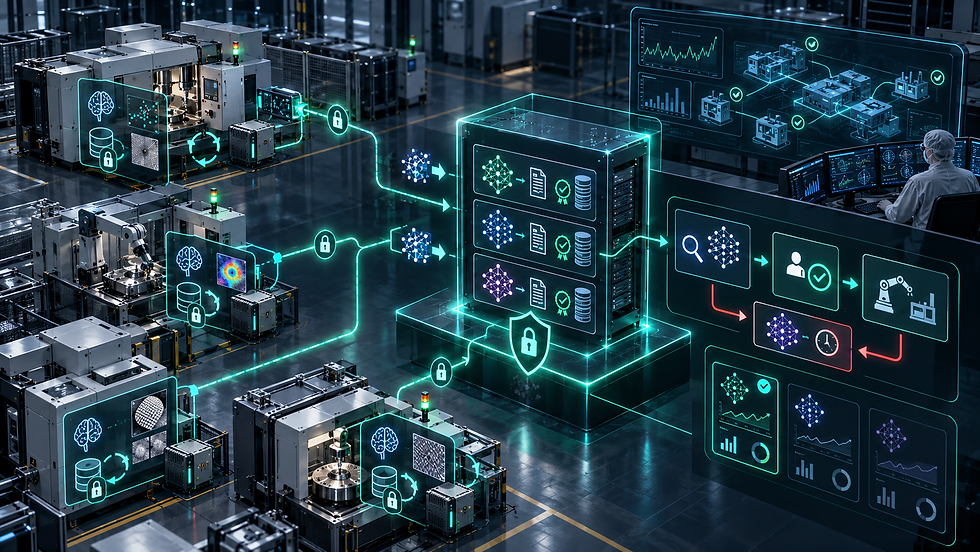
To solve this challenge, Mithril is developing an on-equipment industrial AI operating architecture. Rather than relying on a single isolated model, the core lies in an integrated loop:
Domain-Specific Multimodal Models that simultaneously interpret time-series sensor data, vision inputs, and logs
Edge AI operating directly inside the equipment
Edge MLOps and Federated Learning tailored for air-gapped environment
Evidence-Based Root Cause Analysis (RCA) connecting industrial documentation with operating histories
Safety Layers that restrict corrective recommendations strictly within pre-authorized boundaries
Audit Trails logging human approvals alongside decision rationales
The ultimate goal is not for AI to make every decision autonomously. Rather, it is to connect the entire journey—from detection and root cause analysis to safe corrective proposals and execution history management—into a single closed-loop system.

Why Edge AI Matters
In manufacturing environments, it is not enough for AI to deliver high accuracy in the cloud. In air-gapped environments such as semiconductor fabs, data cannot leave the equipment, and network latency or external connectivity disruptions must never interfere with operational decision-making. Mithril Autonomous OS is designed so that an edge GPU inside the equipment directly analyzes sensors and logs, processing the entire pipeline—from anomaly detection to response—within ultra-low latency. It employs a two-tier operational architecture: a lightweight model continuously monitors baseline operations, while a high-performance model performs precise analysis when an event occurs.
Post-deployment model operation is equally critical. Training and evaluation are performed at the equipment-level edge without exporting raw data externally, synchronizing only signed model weights and metadata internally. To ensure that shop-floor AI evolves beyond a one-off PoC, systems must be equipped with model registries, validated and approved deployment pipelines, real-time performance monitoring, and rollback mechanisms.
How Digital Twins and AI Change the Game
Digital twins must not remain mere tools for visually appealing 3D factory representations. Their more critical value on the shop floor lies in testing changes before implementation.
When adjusting equipment parameters or altering robotic movement paths, teams can first evaluate the potential impacts on throughput, quality, and collision risks within a virtual environment rather than applying them directly to active production lines. However, a decision validated in a virtual environment is not automatically guaranteed to be safe in real-world operations. Factors such as physical equipment degradation, missing sensor readings, and unexpected material variations still demand physical on-site verification. Consequently, the integration of digital twins and AI should be understood not as a technology to eliminate human oversight, but as a framework to simulate broader options and minimize failure costs prior to field implementation.
The Next Competitive Edge in Manufacturing AX
In the era of 5 million robots, the metric manufacturing enterprises must monitor extends far beyond robot installation counts:
How quickly can operations adapt when production conditions change?
How rapidly can root causes be narrowed down after detecting early anomaly signals?
Can the underlying reasoning behind AI-recommended actions be fully traced?
Can model performance degradation be detected and rolled back directly on the shop floor?
Can knowledge gained from a single machine be scaled across other equipment and processes?
Are the experiences of operators and engineers fed back into subsequent decision-making loops?
Mithril's vision for Manufacturing AX stems from these fundamental questions. Industrial AI cannot be realized by models alone. It requires an operational framework that connects with equipment, runs securely within air-gapped networks, learns from shop-floor data and engineering expertise, and delivers verified actions back to the field.
NENYA aims to serve as the industrial AI core and operational platform built for this architecture. Even as it originates in the cleaning process, its core value lies not in remaining confined to a specific application, but in scaling a reasoning structure—one that interprets sensors, vision, and logs, explains anomalies, and translates them into safe actions—across diverse equipment and manufacturing processes.

The Future of Factories Lies in 'Intelligence' Rather Than 'Unmanned Automation'
While the narrative that "robots will replace humans" sounds compelling, real-world transformations on the factory floor are far more complex. A more realistic starting point is an architecture where robots handle repetitive tasks, AI interprets the state of equipment and processes, and humans oversee critical decision-making and exceptional scenarios.
Full automation without human presence may be a long-term direction. However, what manufacturing environments urgently need today is not a system that immediately excludes human operators, but an architecture that structures expert knowledge into data-driven rationales and builds repeatable operational frameworks.
Robot installation counts can be easily quantified. Moving forward, what manufacturing enterprises must measure is what comes next: how rapidly they adapt to changing production conditions, on what evidence they take action upon detecting anomaly signals, and what outcomes those decisions yield for product quality and operational safety.
In the era of 5 million robots, manufacturing competitiveness will no longer be determined by the sheer number of robots, but by the capability of robots, machinery, and humans to operate seamlessly within a single decision loop.


Comments